
law
Cassandra Feuerstein: The Skokie Police Brutality Case That Shocked the Country


Cassandra Feuerstein was a 47-year-old Chicago-area woman who was severely injured while in police custody in Skokie, Illinois, on March 10, 2013. Officer Michael Hart shoved her into a holding cell with enough force that her face struck a concrete bench, fracturing bones around her eye and cheek. Surveillance footage of the incident sparked national outrage. Hart later resigned, pleaded guilty to official misconduct, and the Village of Skokie paid Feuerstein an $875,000 settlement.
Background: Who Is Cassandra Feuerstein?
Before March 2013, Cassandra Feuerstein lived a quiet, ordinary life. She was a working mother in Chicago’s West Rogers Park neighborhood, employed as a receptionist in a Loop office, with no prior criminal record of any kind. She weighed around 110 pounds, stood at average height, and was, by all accounts, someone who had never had a serious run-in with the law.
That changed in the early morning hours of March 10, 2013, when Skokie police found her slumped over in her vehicle at the intersection of Howard Street and East Prairie Road, her foot still resting on the brake pedal. Officers arrested her on suspicion of driving under the influence and took her to the Skokie Police Station for standard booking.
What happened next would change her life permanently — and eventually land her case in courtrooms, news broadcasts, and national conversations about police accountability.
What Happened at the Skokie Police Station
The booking process at a police station is supposed to be routine. Officers photograph and fingerprint a detainee, log their information, and place them in a holding cell while the case is processed. For the vast majority of people, it is uneventful.
For Cassandra Feuerstein, it was anything but.
Surveillance footage from inside the Skokie Police Station captured the entire incident. The video shows Feuerstein being escorted through booking, cooperative throughout the process. At one point, she stepped out of her open holding cell — later accounts indicate officers had directed her out for a booking photo, and she had asked if she could call her husband and children.
Officer Michael Hart, a 19-year veteran of the Skokie Police Department who was involved in her processing, became irate when Feuerstein was not looking in the right direction for her photograph. According to prosecutors, he grabbed her by the arm and pulled her toward the open cell. Feuerstein, apparently trying to regain her balance, placed both hands on the sides of the cell doorway. Hart then placed both hands on her back and shoved her forward.
The force was not slight. Feuerstein flew headfirst into an unpadded concrete bench running the length of the cell. Her face struck the edge of the bench directly. She immediately collapsed to the floor. A pool of blood began forming beneath her.
Officers entered the cell quickly to administer first aid. Paramedics were called. Feuerstein was taken to the hospital.
The Injuries She Sustained
The injuries Cassandra Feuerstein suffered were extensive and life-altering. The impact fractured the orbital bones around her right eye and shattered bones in her cheek. She also sustained loosened teeth, a deep laceration on her cheek, and nerve damage to her face.
She required emergency facial reconstructive surgery. Surgeons implanted a titanium plate in her cheek to hold the fractured bones in place. After the surgery, she still had difficulty eating. The right side of her face remained asymmetrical. Nerve damage meant she continued to experience pain and numbness in her face for years after the incident.
Her attorney, Torri Hamilton, described the aftermath as ongoing — noting that even after criminal proceedings concluded in 2014, Feuerstein still had an abscess on the right side of her face causing swelling. The physical consequences of what happened in that holding cell did not end when the legal cases did.
The Police Report and the Resisting Arrest Charge
After the incident, Officer Hart filed a police report. According to his account, Feuerstein had been uncooperative — refusing to look at the camera for her booking photo — and had “knowingly resisted” by pulling away from him and placing her hands on the sides of the cell door.
Based on that report, Feuerstein was charged with resisting arrest in addition to the original DUI.
Surveillance footage told a different story. When Feuerstein’s attorney obtained the video and released it publicly in October 2013, the resisting arrest charge quickly collapsed. The video showed no aggression, no active resistance, and no threat from Feuerstein. What it showed was a small woman being shoved hard enough to fly headfirst into concrete.
The Cook County State’s Attorney later dropped the resisting arrest charge entirely. Feuerstein ultimately pleaded guilty to the DUI offense and received one year of court supervision.
Criminal Charges Against Officer Michael Hart
Once surveillance footage became public in October 2013, the criminal case against Hart moved quickly. Cook County State’s Attorney Anita Alvarez announced charges and described the evidence as unambiguous.
Hart was charged with two crimes: felony aggravated battery and official misconduct. He was released on a $75,000 bond. The Village of Skokie placed him on paid administrative leave and began an internal investigation. By November 2013, the village announced it would begin termination proceedings. Hart resigned on November 15, 2013, ending his 19-year career with the department.
The criminal case took more than a year to resolve. In November 2014, Hart appeared before Cook County Judge Matthew Coghlan at the Leighton Criminal Court Building. He pleaded guilty to official misconduct. As part of the plea agreement, the more serious felony aggravated battery charge was dropped.
Judge Coghlan sentenced Hart to two years of probation and ordered him to pay $674 in fines. He served no jail time.
At sentencing, Hart read a written statement. He said he had not intended to harm Feuerstein, that he had acted in frustration rather than anger or malice, and that he was sorry for the injuries he caused. Feuerstein was not present in the courtroom to hear it.
Beyond probation, Hart also lost his pension as a result of the felony conviction — a consequence that carried more lasting financial weight than the fine itself.
The Civil Lawsuit and Settlement
Alongside the criminal proceedings, Feuerstein filed a federal civil lawsuit against Officer Hart and the Village of Skokie. The lawsuit alleged excessive force, battery, and police misconduct. It also alleged that Hart had filed a false police report to justify his actions.
The case proceeded through federal court. Two separate settlements were eventually reached.
On September 16, 2015, three officers settled for a combined $625,000. Then, later in September 2015, U.S. District Judge Sharon Johnson Coleman and Magistrate Judge Maria Valdez presided over additional proceedings that brought the total settlement to $875,000.
The Village of Skokie paid the $875,000 without admitting any wrongdoing — a standard condition in many civil settlements with government entities.
For context, $875,000 was a substantial civil settlement, reflecting both the severity of Feuerstein’s physical injuries and the strength of the surveillance video evidence. Cases with clear video documentation of excessive force tend to result in higher settlements than those based solely on competing witness accounts.
Why the Surveillance Video Mattered
Cases of alleged police misconduct often come down to conflicting accounts. Officers describe one version of events; complainants describe another. Without neutral evidence, courts and the public are left to weigh credibility.
The Cassandra Feuerstein case had something that cuts through conflicting narratives entirely: unambiguous video.
The Skokie Police Station surveillance footage showed, in real time, what happened. Viewers could see Feuerstein’s size relative to the officer. They could see that she was not charging at Hart, not swinging at him, not lunging at anyone. They could see the shove, the trajectory of her fall, and the immediate aftermath. Nothing in the video was consistent with the resisting arrest narrative in Hart’s initial report.
When Feuerstein’s attorney Torri Hamilton released the footage publicly in October 2013, media coverage was immediate and national. The video spread widely, generating public attention that accelerated both the criminal and civil processes.
This aspect of the case became part of broader discussions happening at the time — and continuing today — about police body cameras and station surveillance as tools of accountability. The Feuerstein case is frequently cited as a real-world example of how surveillance footage can directly contradict official police reports and protect civilian rights.
How This Case Fits Into Broader Discussions of Police Accountability
The Cassandra Feuerstein case did not occur in isolation. It became part of a national conversation that was already building around police use of force, the use of video evidence, and the accountability mechanisms available to civilians who are harmed in custody.
Several elements of the case made it particularly significant:
The victim’s profile. Feuerstein was not a flight risk, not combative, and not a large physical threat. She was a 110-pound woman in a secured booking area. The use of force was extreme relative to any realistic assessment of the situation.
The false report. The initial police report described her as resisting. The video showed the opposite. The false report raised questions not just about Hart’s actions, but about the institutional culture that allowed a report inconsistent with station surveillance footage to be filed in the first place.
The inadequate punishment. Many observers, including Feuerstein’s own legal team, felt that two years of probation and a $674 fine did not adequately reflect the severity of what happened. Her attorney publicly described the sentence as a “slap on the wrist.” The dropped aggravated battery charge — which could have carried up to five years in prison — was a point of particular frustration.
The no-fault settlement. The $875,000 civil payment from Skokie came without any admission of wrongdoing, which is legally standard but left many feeling that institutional accountability was incomplete.
Common Questions and Misconceptions
Was Feuerstein convicted of a crime?
Yes, but only the original DUI charge. She pleaded guilty to driving under the influence and received one year of supervision. The resisting arrest charge, which came directly from Hart’s police report, was dropped entirely after the video evidence became public.
Did Officer Hart go to prison?
No. Hart pleaded guilty to official misconduct and received two years of probation, $674 in fines, and no jail time. The felony aggravated battery charge was dropped as part of his plea deal. He also lost his police pension as a consequence of the felony conviction.
Did Feuerstein start the altercation?
No. The surveillance video shows no aggressive behavior from Feuerstein. Prosecutors and the video evidence consistently showed that she posed no physical threat and that Hart’s use of force was unprovoked by any threat she presented.
Was the $875,000 settlement an admission of guilt by Skokie?
No. As is standard in civil settlements involving government entities, the Village of Skokie paid the settlement without admitting liability or wrongdoing.
Did Feuerstein fully recover from her injuries?
Not completely. She underwent facial reconstructive surgery, received a titanium plate in her cheek, and experienced lasting nerve damage. Years after the incident, she still had facial swelling from complications. The physical effects of the injury were not temporary.
Key Facts
- The incident occurred on March 10, 2013, at the Skokie Police Station in Skokie, Illinois.
- Cassandra Feuerstein was 47 years old at the time, weighed approximately 110 pounds, and had no prior criminal record.
- Officer Michael Hart was a 19-year veteran of the Skokie Police Department.
- Feuerstein suffered a fractured right orbital bone, shattered cheek bones, loosened teeth, a deep facial laceration, and nerve damage.
- Her treatment included facial reconstructive surgery and a titanium plate implanted in her cheek.
- Hart was initially charged with felony aggravated battery and official misconduct; he pleaded guilty only to official misconduct.
- Hart’s criminal sentence was two years of probation and a $674 fine. He served no jail time.
- Hart resigned from the Skokie Police Department in November 2013 and lost his pension due to the felony conviction.
- The civil settlement totaled $875,000, paid by the Village of Skokie without any admission of wrongdoing.
- The resisting arrest charge against Feuerstein was dropped after surveillance video contradicted Hart’s police report.
FAQ
Q1: Who is Cassandra Feuerstein?
Ans: Cassandra Feuerstein is a Chicago-area woman who was severely injured by a Skokie police officer in March 2013 while in custody following a DUI arrest. Her case became nationally known after surveillance video of the incident was released publicly.
Q2: What happened to Cassandra Feuerstein in 2013?
Ans: While being processed at the Skokie Police Station, Officer Michael Hart shoved Feuerstein into a holding cell with enough force that her face hit a concrete bench. She suffered fractured facial bones, nerve damage, and required reconstructive surgery.
Q3: How much was the settlement in the Cassandra Feuerstein case?
Ans: The Village of Skokie paid a total of $875,000 to settle the federal civil lawsuit. The settlement was paid without any admission of wrongdoing.
Q4: Was there video evidence in the Cassandra Feuerstein case?
Ans: Yes. Surveillance cameras inside the Skokie Police Station captured the entire incident. The footage directly contradicted the initial police report, which described Feuerstein as resisting arrest. After the video was released publicly in October 2013, the resisting arrest charge was dropped.
Q5: Why is the Cassandra Feuerstein case significant?
Ans: The case is significant because it illustrates how station surveillance footage can contradict official police reports, how excessive force can occur in a secured booking environment with no legitimate threat, and how the gap between civilian harm and officer punishment plays out in practice. It is frequently cited in discussions of police accountability, false reporting, and civil litigation for excessive force.
Key Takeaways
- Cassandra Feuerstein was a cooperative DUI detainee with no history of violence who was severely injured in police custody at the Skokie, Illinois police station in March 2013.
- Officer Michael Hart shoved her into a concrete bench during booking after she did not comply with a photo instruction, fracturing bones in her face and causing lasting nerve damage.
- Surveillance video of the incident directly contradicted Hart’s official police report, which had claimed she was resisting arrest.
- Hart resigned, pleaded guilty to official misconduct, received two years probation and a $674 fine, and lost his pension. He served no jail time.
- The Village of Skokie settled the civil lawsuit for $875,000 without admitting wrongdoing.
Conclusion
The Cassandra Feuerstein case remains one of the clearer examples of documented excessive force in a police custody setting. The facts were not disputed because they were captured on video. The outcome — a resignation, a probation sentence, and an $875,000 municipal settlement — continues to be discussed when people examine how accountability systems respond when officers use force that clearly exceeds what the situation required.
Feuerstein herself did not emerge from the case unscathed. The physical injuries she sustained were real, lasting, and serious. Her story is ultimately about what happens when a routine arrest becomes something far more harmful, and about what video evidence can and cannot guarantee in terms of justice for those who are harmed.

Here’s a question that trips up more people than you’d expect: how long, exactly, do you have to lodge a claim after a car accident? Not “eventually,” not “whenever life calms down.” There’s an actual clock running, and it starts ticking the moment the crash happens, whether you’re paying attention to it or not. Miss it, and even a rock-solid case can get shut down before anyone even looks at the details.
Why There’s a Deadline at All
Limitation periods exist for reasons that actually make sense once you think about it. Evidence fades. Memories blur. Witnesses move overseas, or just forget. The legal system wants disputes resolved while the facts are still fresh enough to sort out fairly, rather than years later when nobody can quite agree on what actually happened. Frustrating in the moment, sure. But not arbitrary.
The General Timeframe in NSW
In New South Wales, motor vehicle accident claims generally need to be lodged within three months of the accident for the compulsory third party insurance claim, though this can shift depending on the type of claim and the specific circumstances involved. There’s also a broader six-month window that applies in certain situations, and separate rules again if court proceedings become necessary. Confusing? A bit. That’s exactly why guessing your own deadline based on something you half-remember reading online is a genuinely risky move.
- CTP claims generally need to be lodged within a matter of months, not years
- Extensions can sometimes be granted, but they’re not guaranteed and need proper justification
- Court proceedings, if they become necessary, run on a separate and often longer timeframe
- Different rules can apply depending on whether a child, a fatality, or an interstate element is involved
What Happens If You Miss It
Missing a limitation period doesn’t automatically mean the door slams shut forever, but it does make everything harder. Late claims require additional justification, sometimes formal applications explaining the delay, and there’s no guarantee an insurer or court will accept the reasoning. Some do get through. Plenty don’t. It’s a genuine risk, not a technicality that quietly sorts itself out.
Why People End Up Missing the Deadline
It’s rarely laziness. Usually it’s something far more human. Someone assumes their injuries are minor and will resolve on their own, only for symptoms to worsen months later. Someone’s dealing with the emotional aftermath of the crash and simply isn’t in a headspace to chase paperwork. Someone assumes the other driver’s insurer will “sort it out,” without realising that’s not actually how any of this works. None of these are unreasonable responses to a stressful situation. They just happen to collide with a strict clock that doesn’t pause for any of it.
Injuries That Sneak Up on You
Whiplash, soft tissue damage and concussion symptoms these don’t always show up immediately. Adrenaline masks pain for hours, sometimes days, after a crash. By the time symptoms are undeniable, weeks might have already ticked by. This is exactly why getting checked out promptly after any accident matters, even if you feel more or less fine at the scene. Feeling fine at the scene and being fine are not always the same thing.
Not Just Cars: Cyclists and Other Road Users
It’s not only drivers who need to keep an eye on these timeframes. Cyclists involved in collisions with vehicles face the same kind of ticking clock, and the rules around what’s covered can get genuinely tricky. This article on bicycle crash compensation options in NSW explains what’s covered and what isn’t, making it worth a look if a bike was involved in any part of the incident, even peripherally.
Extensions Do Exist — Sometimes
Courts and insurers understand that life doesn’t always cooperate with legal deadlines. Genuine medical reasons, a delayed diagnosis, or circumstances entirely outside your control can sometimes support an extension request. But “sometimes” is doing a lot of heavy lifting in that sentence. These aren’t automatic, and the longer the delay stretches, the harder the argument becomes. Waiting to see “if things get worse” before acting is one of the riskiest strategies going, purely because of how these timeframes work.
The Smartest Move: Don’t Wait to Find Out
Here’s the things that you don’t need to have every detail sorted, every document collected, and every symptom fully diagnosed before starting the process. Getting advice early doesn’t commit you to anything irreversible. It just means someone who actually knows the current rules can tell you exactly where your personal clock stands, rather than you trying to reverse-engineer legislation from a forum post at midnight.
If you’ve been in an accident, even one that felt relatively minor at the time, it’s worth having a proper conversation about your motor vehicle accident claim sooner rather than later. Deadlines in this area move fast, and the cost of finding out too late is far higher than the cost of a conversation now.
What If Someone Else Was Also Hurt?
Accidents involving multiple injured parties, or a fatality, often trigger different processes entirely, sometimes running on separate timeframes with their own rules. If your accident wasn’t a simple single-vehicle, single-injury situation, treat that as an extra reason to get clarity fast rather than assuming the standard timeframe automatically applies to your exact circumstances.
Documenting the Timeline as You Go
One habit that helps enormously: keep a simple record of dates. When the accident happened. When you first saw a doctor. When symptoms changed. When you first spoke to an insurer. It sounds almost too basic to matter, but a clear timeline removes a huge amount of the guesswork later, both for your own peace of mind and for anyone assessing your claim.
A Quick Gut-Check Question
If you’re not sure whether you’re inside your window right now, ask yourself this: has it been more than a couple of months since the accident, and have you done nothing formal about a claim yet? If the answer is yes to both, treat that as your cue to check your position today, not next week. The margin for comfortable delay is smaller than it feels.
Wrapping This Up
Limitation periods aren’t designed to trip people up out of spite, but they will trip you up if you’re not paying attention. The safest approach is simple, even if it’s not thrilling: don’t sit on it. Get checked medically as soon as possible after any accident. Get advice early, even if you’re not sure whether you’ll pursue a claim at all. The window is smaller than most people assume, and once it closes, no amount of good evidence or genuine injury changes that fact.
This information is general in nature and doesn’t replace advice specific to your circumstances. Time limits can shift depending on the details of your situation, so it’s always worth checking your exact position rather than assuming.

Roads, drainage systems, utility infrastructure, reservoirs, parks, public facilities, and other major projects often require land that is already privately owned. Texas law gives certain governmental entities the power of eminent domain to acquire private property when it is needed for a qualifying public use, but that authority comes with constitutional limits.
The normal process is straightforward in principle: the condemning authority identifies the property rights it needs, attempts to acquire them from the owner, and, if an agreement cannot be reached, uses the formal condemnation process to determine compensation. Texas property owners are entitled to adequate compensation when their property is condemned for public use.
Problems can arise, however, when a government project takes, damages, destroys, or substantially interferes with private property without first using that formal process or paying the owner. Depending on the facts, that situation may give rise to an inverse condemnation claim in Texas.
Why Would the Government Need Private Property for a Public Project?
Government agencies cannot always build infrastructure exclusively on property they already own. Roads have to connect existing transportation networks. Water and drainage systems must follow engineering and topographical requirements. Utility corridors must cross particular areas. Flood-control infrastructure may need to be located where water naturally moves.
As a result, a public project may require the acquisition of a particular tract, a strip of land, an easement, or another property interest.
The Texas Attorney General’s Landowner’s Bill of Rights identifies roadways, public utilities, parks, universities, and other public infrastructure as examples of projects that may constitute public uses. Texas law also recognizes public roads and highways, water-supply systems, wastewater infrastructure, flood-control and drainage projects, and utility services among purposes for which eminent-domain authority may exist.
That does not mean the government has unlimited authority to take property merely because officials believe a project would be beneficial. Texas law restricts the use of eminent domain for certain private-benefit and economic-development purposes, and the Texas Constitution requires a qualifying public use.
Formal Condemnation and Inverse Condemnation Are Different
The distinction is important for landowners.
In a conventional condemnation case, the entity exercising eminent domain initiates the process. Texas Property Code Chapter 21 generally governs condemnation proceedings, and a condemning authority must attempt to acquire the necessary property before filing a condemnation petition when the parties cannot agree.
An inverse condemnation case works in the opposite direction. Instead of the government filing the case to acquire property, the property owner brings the claim because government action has allegedly taken or damaged private property without providing constitutionally required compensation.
The Texas Supreme Court has explained that an owner who believes the government has taken property may pursue inverse condemnation to recover adequate compensation. The Texas Constitution protects property that is not only “taken,” but also property that is “damaged” or “destroyed” for or applied to public use.
This distinction matters because a government agency may formally condemn one portion of a property while its project creates additional effects outside the acquired area. In other situations, there may be no formal condemnation proceeding at all even though the government’s actions substantially affect private property.
How Can a Public Project Potentially Create an Inverse Condemnation Claim?
A public project does not have to involve the government literally taking title to an owner’s entire parcel before constitutional property protections become relevant.
According to the Texas Supreme Court, an inverse-condemnation claim requires a landowner to establish several components, including affirmative governmental conduct, causation, a taking, damaging, destruction, or application of specific private property, a public use, lack of adequate compensation, and the required level of governmental intent or knowledge.
Several project-related situations illustrate how these issues can develop.
A Public Project Causes Repeated Flooding
Flooding is one of the most significant examples in Texas inverse-condemnation litigation.
Suppose a governmental entity builds or modifies a roadway, reservoir, drainage facility, flood-control structure, or other public improvement. The project changes the movement of water and causes identifiable private property to flood.
The existence of damage alone does not automatically establish an inverse condemnation claim. Texas courts examine whether there was affirmative government conduct, whether that conduct caused the damage, and whether the government had the required knowledge or intent.
The Texas Supreme Court has explained that, in this context, a property owner generally must show that the government knew its conduct was causing identifiable harm or that specific property damage was substantially certain to result. Mere negligence is not enough.
That distinction can make engineering reports, drainage studies, prior flooding, project plans, internal communications, and the history of the government’s actions particularly significant.
A Transportation Project Substantially Impairs Property Access
Road construction may require formal acquisition of frontage, but the effects of the project can extend beyond the land physically acquired.
Changes to road elevation, driveways, medians, intersections, frontage roads, or access points can affect how remaining property can be reached and used. Not every inconvenience or change in traffic patterns creates a compensable taking. Texas precedent, however, has recognized that property may be constitutionally damaged when access is materially and substantially impaired, depending on the circumstances.
For commercial, agricultural, industrial, or development property, the difference between inconvenience and substantial impairment can have major consequences for the property’s remaining utility and value.
Government Occupies Property Outside the Rights It Acquired
A government entity may acquire an easement or defined strip of property for a project. If construction or operation later results in a physical occupation or invasion outside the rights that were actually acquired, the owner may need to determine whether an additional taking has occurred.
Physical occupation is among the clearest forms of governmental interference with property rights. Texas courts recognize both physical takings and regulatory takings.
The exact location and language of deeds, easements, surveys, construction plans, and right-of-way documents can therefore become critical.
A Regulation Connected to a Public Objective Goes Too Far
Inverse condemnation is not limited to bulldozers, pipelines, roads, or flooding.
Government regulation can sometimes restrict private property so severely that the restriction becomes the functional equivalent of a taking. In its 2025 decision involving The Commons of Lake Houston, the Texas Supreme Court held that the fact that a city regulation was adopted pursuant to the government’s police power and for an important public objective did not automatically prevent a property owner from asserting a regulatory-takings claim.
Regulatory-taking cases are highly fact-specific. Courts may examine the economic impact of the regulation, its effect on reasonable investment-backed expectations, the character of the governmental action, and other relevant circumstances.
Not Every Loss Caused by a Government Project Is Inverse Condemnation
Landowners should be careful not to treat every negative effect from public construction as a constitutional taking.
Noise, temporary inconvenience, reduced traffic, construction delays, general market changes, or negligent government conduct do not necessarily establish inverse condemnation. Texas law requires more than proof that a public project happened and a property owner suffered a loss.
Among the most important questions are:
- What affirmative action did the governmental entity take?
- What specific private property was affected?
- Did that action actually cause the alleged damage?
- Was the property taken, damaged, destroyed, physically occupied, or substantially restricted?
- Was the property being affected in connection with a public use?
- Did the government know the harm was occurring or that specific damage was substantially certain to result?
- Has adequate compensation already been provided?
The Texas Supreme Court has repeatedly distinguished actionable takings from government negligence. The required analysis focuses heavily on affirmative governmental conduct, causation, and the government’s knowledge of the resulting property impact.
Why Landowners Should Evaluate the Entire Project Impact
When a government entity approaches a landowner for property, attention naturally focuses on the acreage or easement shown on the acquisition map. That may be only part of the economic impact.
A roadway can alter access. A utility easement can affect development plans. A drainage project can change water flow. A partial acquisition can change the highest and best use of the remainder. Construction can also reveal impacts that were not obvious when the government’s original offer was made.
Texas’s Landowner’s Bill of Rights specifically recognizes that compensation may include certain damages when the value of the owner’s remaining property is diminished by the condemnation or the public project for which the land is being acquired.
For that reason, the correct valuation question is often broader than, “What is the square footage of the land the government wants?”
The more important question may be, “What happens to the entire property because of this project?”
The Public May Benefit, but One Landowner Should Not Automatically Bear the Cost
Public infrastructure is necessary. Texas communities need transportation networks, utilities, drainage systems, flood-control projects, and other improvements.
The constitutional issue is not whether those projects should exist. It is who should bear their cost.
Texas takings law is built around the principle that government may pursue legitimate public improvements, but private property owners should receive constitutionally required compensation when their property is taken or damaged for those public purposes. The Texas Supreme Court has described this framework as balancing private-property rights against the demands of public progress.
When the government uses the formal eminent-domain process, the dispute may center on the amount of adequate compensation. When government action causes a taking or compensable property damage without initiating condemnation, the landowner may instead need to examine whether an inverse condemnation claim in Texas is available.
Because these cases often turn on engineering, causation, property valuation, government knowledge, access, land use, and the precise nature of the public project, landowners facing substantial government-caused property impacts should evaluate the situation before assuming the damage is simply an unavoidable consequence of public development.
This article provides general educational information and is not a substitute for legal advice concerning any specific property or condemnation matter.
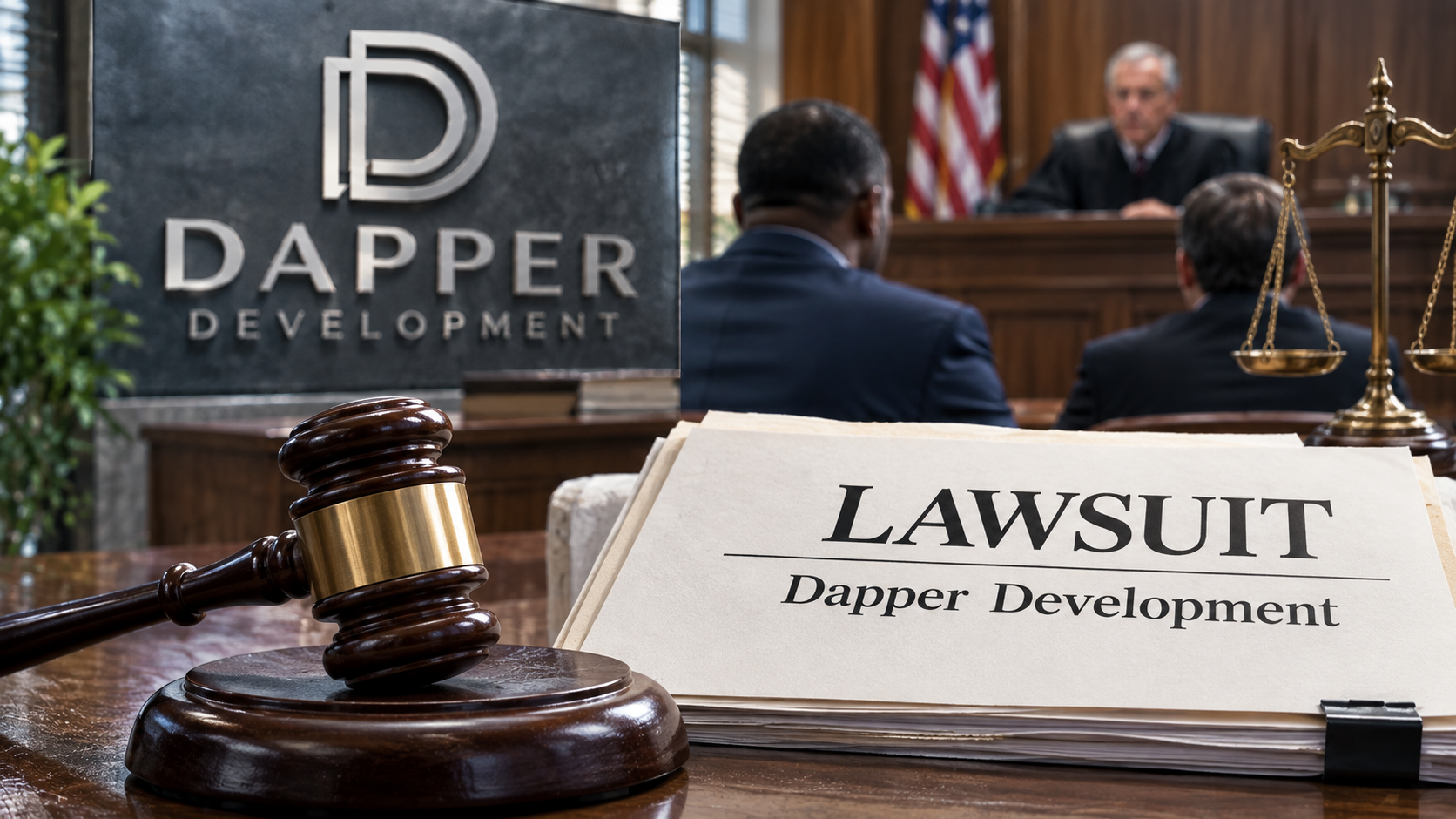
Search Dapper Development lawsuit, and you’ll find a confusing mix of explanations, some describing a real estate investor fraud case, others tying it to an entirely unrelated NFT company. Only one of these matches what’s actually in the court record. This breaks down what the real case involves, based on published court opinions, and clears up where the online confusion comes from.
Direct Answer: What Is the Dapper Development Lawsuit?
The Dapper Development lawsuit refers to Dapper Dev., L.L.C. v. Cordell, a business ownership dispute filed in the North Carolina Business Court. It involves Dapper Development, L.L.C., a real estate firm that builds new homes and renovates and resells single-family homes, along with an affiliated company, Tantalum Holdings, LLC. The case centers on the 2023 removal of co-owner Andrew Cordell and the disputed buyout of his 25% ownership interest, not on claims of investor fraud or securities violations.
Who’s Involved
The dispute involves four individuals who each held a 25% ownership interest in both Dapper Development, L.L.C. and Tantalum Holdings, LLC. Court records identify the three remaining owners as Brendan Gelson, Kyle Tudor, and Mason Harris, with Andrew Cordell as the fourth member whose removal triggered the litigation. Under the companies’ operating agreements, each member also served as a manager, giving all four a formal role in company decisions before the dispute began.
How the Dispute Started
According to the published court record, tensions among the co-owners led the three remaining members to vote to remove Cordell from both companies in June 2023, offering him a cash payment for his ownership stake as part of a buyout. Cordell rejected that initial offer and made a counteroffer, which the other owners rejected in turn.
Cordell then filed an initial lawsuit against the other owners. During continued negotiations over the buyout, he voluntarily dismissed that first lawsuit without prejudice on April 10, 2024, a legal move that allows a case to be refiled later rather than permanently closing it. Shortly after, in April 2024, Dapper Development and Tantalum Holdings filed a new lawsuit against Cordell, initiating the case that’s now the primary subject of the Dapper Development lawsuit searches.
What the Companies’ Lawsuit Claims
The complaint filed by Dapper Development and Tantalum Holdings against Cordell raises several distinct legal claims, based on the published court opinion:
- Breach of contract, alleging Cordell failed to abide by the terms of the companies’ operating agreements
- Declaratory judgment, asking the court to formally determine the rights, duties, and liabilities between the parties under those agreements
- Breach of the implied duty of good faith and fair dealing
- Breach of contract related to a separate consent order reached during the earlier, dismissed lawsuit
- Abuse of process
Cordell, in response, filed his own counterclaims against the other owners, meaning the case involves claims moving in both directions rather than a single party simply defending against allegations.
What Courts Have Actually Resolved So Far
Based on the published July 2025 merits order from the North Carolina Business Court, a few specific issues have been formally resolved. The court confirmed that Cordell ceased to be a member and manager of the companies as of June 14, 2023, settling a key question about when his ownership status legally ended. The court also confirmed that Dapper Development received a financial credit of $181,807.51 tied to a specific property, referred to in court records as the Winston Property.
Beyond these specific rulings, published court records don’t confirm a final settlement, a trial verdict, or any broader financial payout. This is an important distinction, since some online sources describe the case as resolved with a specific multimillion-dollar settlement figure, a claim not supported by the available published court record as of the most recent order.
Clearing Up Widespread Online Confusion
This case has become genuinely difficult to research accurately because of how differently it’s described across different websites, and it’s worth addressing directly.
Confusion with Dapper Labs
Several online sources conflate this case with entirely separate litigation involving Dapper Labs, the technology company behind the NBA Top Shot NFT platform. Dapper Labs has faced its own distinct legal matters, including a securities class action related to NBA Top Shot NFTs and a separate privacy lawsuit related to data tracking. These cases involve different companies, different parties, different legal claims, and different courts than the Dapper Development LLC dispute. The shared word “Dapper” in both names appears to be coincidental, not evidence of any actual connection between the companies.
A fabricated investor-fraud narrative
Separately, some published content describes “Dapper Development” as a real estate firm facing a lawsuit from investors and property buyers over alleged misrepresentation of project readiness and financial stability during an aggressive expansion phase. This narrative doesn’t match the actual court record, which describes an internal ownership dispute among four business partners, not a case brought by outside investors or property purchasers.
Unverified settlement figures
At least one source cites a specific $7.05 million settlement figure tied to the Dapper Development name. This figure isn’t confirmed by the published North Carolina Business Court record, and more careful research into the case’s actual docket explicitly flags this kind of claim as unverified.
Given how mixed the available information is, anyone researching this case should prioritize the actual court record, case number 24CV018718-590 in the North Carolina Business Court, over general web content that may conflate unrelated cases or present unconfirmed details as settled fact.
Good to Know
This is a private business dispute, not a consumer protection case. Unlike class action lawsuits involving large groups of consumers or investors, this case involves four individuals with a direct ownership stake in the same two companies, disputing the terms of their own exit and buyout.
The case has already gone through one prior dismissed lawsuit. Cordell’s initial suit against the other owners was voluntarily dismissed without prejudice in April 2024, meaning the current, active case is technically the second legal filing connected to this ownership dispute.
Court opinions are public record and the most reliable source. Because online coverage of this case varies so widely in accuracy, the published opinions from the North Carolina Business Court remain the most dependable way to confirm what’s actually been decided.
Key Facts
- The Dapper Development lawsuit refers to Dapper Dev., L.L.C. v. Cordell, case number 24CV018718-590, in the North Carolina Business Court.
- It’s an internal ownership dispute involving four co-owners of Dapper Development, L.L.C. and Tantalum Holdings, LLC.
- Andrew Cordell was removed as a member and manager effective June 14, 2023, a fact confirmed by the court.
- The court confirmed a $181,807.51 credit to Dapper Development tied to a specific property.
- No final settlement or trial verdict is confirmed in published court records as of the most recent available order.
- This case has no confirmed connection to Dapper Labs, the NFT company behind NBA Top Shot, despite online content that conflates the two.
Frequently Asked Questions
Q1: What is the Dapper Development lawsuit about?
Ans: It’s a business ownership dispute in North Carolina, centered on the 2023 removal of co-owner Andrew Cordell from Dapper Development, L.L.C. and Tantalum Holdings, LLC, and the disputed value and terms of his ownership buyout.
Q2: Is this the same as the Dapper Labs NFT lawsuit?
Ans: No. Despite the similar name, Dapper Development is a real estate firm, entirely unrelated to Dapper Labs, the technology company behind NBA Top Shot, which has faced its own separate securities and privacy litigation.
Q3: Has the Dapper Development lawsuit been settled?
Ans: Published North Carolina Business Court records don’t confirm a final settlement as of the most recent available order. Some online sources cite a specific settlement figure, but this isn’t supported by the published court record.
Q4: Who are the parties in the case?
Ans: The case involves Dapper Development, L.L.C. and Tantalum Holdings, LLC as plaintiffs, along with co-owners Brendan Gelson, Kyle Tudor, and Mason Harris, against former co-owner Andrew Cordell as defendant.
Q5: What has the court actually decided so far?
Ans: The court confirmed that Cordell’s membership and manager status ended June 14, 2023, and that Dapper Development is owed a $181,807.51 credit related to a specific property, among other issues addressed in a July 2025 merits order.
Q6: Is this a class action lawsuit?
Ans: No. It’s a private dispute between a small number of individual business co-owners over an internal buyout, not a class action involving a broader group of consumers or investors.
Key Takeaways
- The Dapper Development lawsuit is a real North Carolina LLC ownership dispute, not an investor fraud case or a class action.
- It centers on the 2023 removal and disputed buyout of co-owner Andrew Cordell from two affiliated real estate companies.
- Courts have resolved specific issues, including Cordell’s membership termination date and a financial credit, but no final settlement is confirmed in published records.
- The case has no verified connection to Dapper Labs or its separate NFT-related litigation, despite online content suggesting otherwise.
- Checking the actual published court record is the most reliable way to understand what’s genuinely been decided in this case.
In Short
The real Dapper Development lawsuit is a fairly ordinary, if legally involved, business ownership dispute between four real estate co-owners, not the dramatic investor fraud story or NFT-adjacent case that some online content suggests. Getting an accurate picture means separating the verified court record, confirmed through published North Carolina Business Court opinions, from unrelated litigation and unconfirmed claims that have gotten tangled up with the same search term.
-

 Technology2 months ago
Best Wireless Earbuds Under 200 Dollars 2024: What to Know Before You Buy
-

 News4 months ago
Best Places to See Penguins in the Wild: A Complete Guide
-

 Technology4 months ago
What Is VIPstand? How It Works, Legal Risks, and What You Should Know
-
 News4 months ago
Lake Mead Water Levels: Status, History & Western Impact
-

 Technology4 months ago
Laaster: Meaning, Origins, and What It Says About Harmful Speech
-

 Celebrity4 months ago
Matt Danzeisen: Who He Is, His Career in Finance, and His Life With Peter Thiel
-

 News4 months ago
What Is Epoch Fun? A Complete Guide to the Epoch Times Games Section
-

 Food2 months ago
Best Arroz con Leche Boliviano Near Me: What to Look For