
Lifestyle
Retirement Gifts for Men: Thoughtful Ideas for Every Interest and Budget

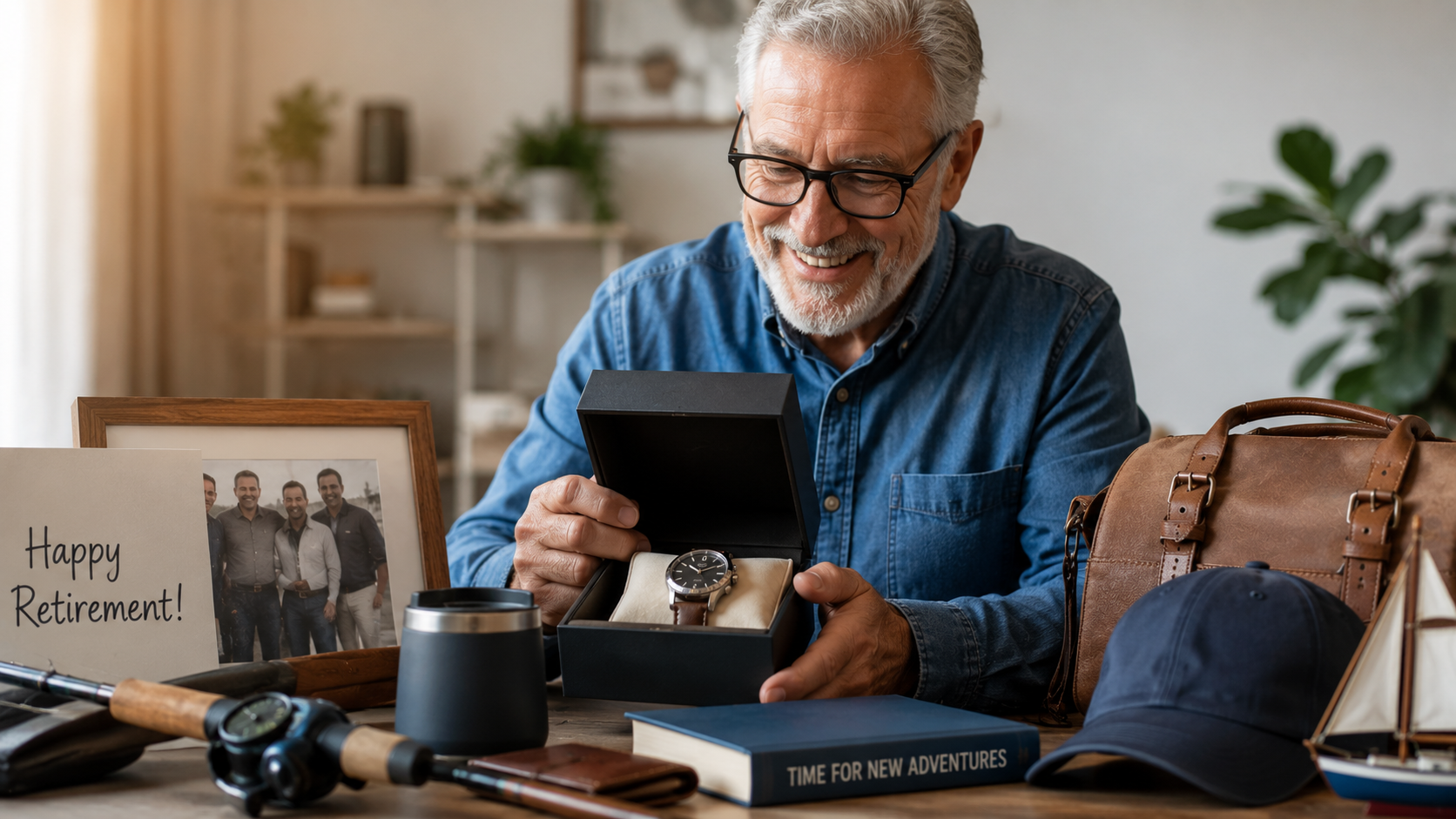
Finding the right retirement gift for a man can feel surprisingly tricky. He’s spent decades being useful, productive, and professional — and now everything changes. The challenge isn’t just picking something he’ll like. It’s choosing something that actually fits the life he’s stepping into, not the one he’s leaving behind.
Whether you’re shopping for a father, husband, colleague, boss, or close friend, this guide covers what makes a retirement gift meaningful, which categories tend to land well, and how to think about the person in front of you rather than defaulting to the obvious choices.
What Makes a Good Retirement Gift for a Man?
Good retirement gifts for men are thoughtful, personal, and forward-looking. The best options reflect his interests outside of work, celebrate the milestone without being generic, and ideally give him something to look forward to in his next chapter. These gifts can be experiences, practical items for a hobby, sentimental keepsakes, or tools for relaxation and adventure — depending on the man.
A good retirement gift does one of the following:
- Acknowledges what he’s accomplished
- Supports something he’s always wanted to do but never had time for
- Makes his daily retired life more enjoyable
- Creates a lasting memory of the milestone
What it generally shouldn’t do is feel like something bought in a hurry from a gift shop. Engraved golf balls and “World’s Best Retiree” mugs have their place, but if you know the person well, you can almost certainly do better.
How to Choose the Right Retirement Gift
Before jumping to specific ideas, it helps to think through a few questions. What does he actually enjoy doing? What has he talked about wanting to do when he retires? Is he the type who values experiences over objects, or does he prefer something tangible he can use every day?
Consider these angles:
His hobbies and passions. A man who golfs every weekend has different needs than one who’s been quietly dreaming about fly fishing, woodworking, or travel. The best gifts extend naturally from what he already loves.
The chapter he’s entering. Some men retire into adventure — travel, sports, outdoor pursuits. Others retire into calm — gardening, reading, cooking. Matching the gift to his retirement personality matters.
Your relationship with him. A spouse can give something deeply personal. A workplace colleague might go for something celebratory. A child or close friend might aim for something meaningful and long-lasting.
Your budget. Meaningful gifts exist at every price point. A handmade photo book can outperform an expensive but impersonal gadget every time.
Retirement Gift Ideas for Men Who Love the Outdoors
Men who spend their free time outside tend to be some of the easiest people to shop for — because their interests come with a clear gear list. The trick is giving something they’d genuinely use, not something that ends up in the garage.
Fishing
Fly fishing in particular has become something of a retirement dream for many men. A quality fly rod, a guided fishing trip, or a weekend at a fishing lodge all make memorable gifts. Even a set of hand-tied flies from a local expert feels special and personal.
For the casual angler, a well-stocked tackle box refresh or a fishing kayak can open up entirely new experiences.
Hiking and National Parks
A National Parks annual pass — commonly called the America the Beautiful pass in the US — is an excellent practical gift for the man who loves hiking and wants to explore. It covers entry to over 2,000 federal recreation sites for a full year. Many countries have similar passes for their national park systems.
Pair it with a quality daypack, trekking poles, or a guided hiking trip and you’ve put together a genuinely memorable retirement gift set.
Golf
Golf is almost synonymous with retirement for a reason — it’s a social, outdoor activity that fits a flexible schedule perfectly. Useful gifts here include range finders, high-quality gloves, custom-monogrammed golf balls (done well, these are actually appreciated), or membership to a club he’s always wanted to join.
A golf trip with friends or family to a destination course can also be one of those gifts he talks about for years.
Camping and Adventure
For the man who’s been saying “I want to go camping more when I retire,” a quality tent, a portable camp kitchen setup, or a hammock-and-tarp system can bring that plan into reality. If he already has the gear, consider booking the trip itself — a wilderness cabin stay, a guided canoe trip, or an RV rental for a road adventure.
Retirement Gift Ideas for Men Who Enjoy Food and Drink
Food and drink gifts sit comfortably at most budget levels and work well for almost any man, particularly when chosen with some specificity.
Whiskey and Spirits
A bottle of aged single malt Scotch whiskey or a small-batch bourbon he wouldn’t normally buy for himself is a classic for a reason. Better still, sign him up for a whiskey tasting experience or a distillery tour. These combine the drink with a memorable outing and often make a stronger impression than the bottle alone.
A whiskey decanter set with his name or retirement date engraved adds a personal touch that elevates an otherwise simple gift.
Coffee
For the man who’s spent 30 years dependent on office coffee, retiring can actually be the moment he finally gets serious about the craft. A quality burr grinder, a pour-over setup, or a subscription to a specialty roaster makes a practical and enjoyable gift. Some specialty roasters even offer personalized retirement blends for gift orders.
Cooking and Grilling
Many men who retire discover (or rediscover) genuine interest in cooking when they have more time. A cast iron skillet, a quality chef’s knife, a smoker, or a pizza oven for the backyard all fit this category well. A cooking class — especially one focused on something specific like butchery, pasta making, or open-fire cooking — can be a standout experiential gift.
Retirement Gift Ideas for the Traveler
Retirement is the moment many men finally have both the time and the reason to travel. Gifts that support this can range from practical travel gear to fully planned experiences.
Travel Accessories
A quality leather carry-on bag, noise-canceling headphones, a travel wallet, or a well-organized packing system all make useful and appreciated gifts for the man planning to travel more. These work particularly well as group gifts from a workplace team or group of friends.
Experience-Based Travel Gifts
Booking a trip — or contributing toward one — is often more meaningful than any physical object. A river cruise, a guided cultural tour, or a weekend at a destination the retiree has always mentioned wanting to visit can serve as the gift itself.
If you’re not sure which trip to plan, a voucher toward a travel agent or a travel fund contribution (through a platform that lets people contribute toward a specific goal) gives him full control.
Travel Journals and Maps
A high-quality leather travel journal or a scratch-off world map works especially well as a companion gift — something to pair with the adventure itself. Men who keep records of their travels often become quite attached to a good journal over years of use.
Retirement Gift Ideas for the Home and Garden
Some men retire into their home life with genuine enthusiasm. Gardening, DIY projects, woodworking, and home improvement become serious pastimes.
Gardening
A quality set of gardening tools, a raised bed kit, or a season of a local CSA (community-supported agriculture) box can all speak directly to the man who’s been saying he’ll finally get that garden going. A greenhouse kit or a subscription to seed company deliveries can also be particularly enjoyable over time.
Woodworking and DIY
If he’s been talking about finally setting up a proper workshop, contributing toward a tool — a quality hand plane, a scroll saw, or a router table — can be a meaningful and practical gift. Many men who retire into woodworking describe it as the most satisfying thing they’ve ever done with their hands.
A woodworking class or a weekend course at a local community college or maker space gives him both skills and a social experience to go along with it.
Sentimental and Personalized Retirement Gifts
Sometimes the most memorable gifts are the ones that can’t be bought off a shelf. Personalized and sentimental gifts take more effort to create, but they almost always leave a stronger impression.
Photo Books and Memory Albums
A professionally printed photo book covering his career, family life, or key memories is a deeply personal gift. Services like Artifact Uprising and Chatbooks allow you to build high-quality books that look and feel substantial.
For a workplace gift, a photo book featuring team photos, messages from colleagues, and notable moments from his career can be something he genuinely treasures.
Engraved Items
A quality watch, a leather wallet, a flask, or a set of cufflinks engraved with his name, retirement date, or a short personal message can elevate a practical gift into something lasting. The key is choosing quality over novelty — an engraved item on something he’ll actually use every day carries far more meaning than a decorative item that sits on a shelf.
Letters and Messages from People He Cares About
For some men, a collection of handwritten notes or short video messages from family, friends, and former colleagues means more than any object. This is particularly true for men who are retiring after long careers built on relationships. Coordinating this takes effort, but the result is often unforgettable.
Retirement Gift Ideas by Budget
Under $50
- A National Parks pass
- A specialty coffee subscription (one month)
- A personalized engraved pint glass or flask
- A quality paperback or hardcover book on a topic he loves
- A fishing tackle refresh
- A scratch-off travel map
$50 to $150
- A whiskey tasting experience
- A cooking class
- A quality leather journal
- A monogrammed golf accessory set
- A cast iron skillet or quality kitchen knife
- A subscription box tailored to his interests (coffee, spirits, books, outdoors gear)
$150 to $500
- A quality fly rod or fishing kayak accessories
- Noise-canceling headphones
- A custom-printed photo book with professional binding
- A set of engraved barware or a whiskey decanter set
- A camping gear upgrade
$500 and Above
- A golf club membership or greens fees at a destination course
- A guided fishing or hunting trip
- A distillery or winery experience weekend
- A contribution toward a planned trip or cruise
- A quality woodworking tool or workshop setup
Common Mistakes When Choosing Retirement Gifts for Men
Defaulting to the generic. “World’s Best Retiree” items, golf ball sets with no personalization, and novelty office-themed gifts often feel like afterthoughts. If you know the person, invest a little thought into what actually fits him.
Buying for who he was at work. A man stepping away from a 30-year career doesn’t necessarily want a gift that reminds him of the office. Think about who he’s becoming, not who he was from nine to five.
Underestimating experiences. Physical gifts are easy to wrap and hand over, but experiences — a trip, a class, a tasting, a guided outing — often produce memories that last far longer than objects. Many retirees say experiential gifts were among the most meaningful they received.
Group gifts gone wrong. Workplace group gifts pooled together without coordination sometimes end up being generic gift cards or uninspired items. If a group is contributing, it’s worth someone taking charge of choosing something intentional with the total budget.
Waiting too long. Retirement often comes with a specific date, and some experiential gifts (guided tours, fishing lodges, destination trips) book up well in advance. Start thinking about the gift early if you’re planning something experience-based.
Frequently Asked Questions
Q1: What is the most popular retirement gift for men?
Ans: Experiences tend to be remembered most fondly — trips, guided outings, tasting events, and classes. Among physical gifts, personalized items like engraved watches, quality barware, and custom photo books are consistently well received. Golf-related gifts are popular but work best when chosen with the specific person in mind.
Q2: How much should you spend on a retirement gift?
Ans: There’s no set rule. Workplace gifts from a team often range from $50 to $200 per person contributing. Individual gifts from family members can range from $100 to several hundred dollars. The most meaningful gifts at any price level are the ones that show genuine thought about the person receiving them.
Q3: What do you get a man who has everything?
Ans: Focus on experiences rather than objects. A guided trip, a cooking class, a distillery tour, or a weekend away tends to resonate with men who already have the physical things they need. Alternatively, something deeply personal — like a curated photo book or collected letters from family — can be more meaningful than anything purchasable.
Q4: Is it appropriate to give a retirement gift from the whole office?
Ans: Absolutely. Group gifts are common and often allow for something more substantial than a single person might give. The key is having one person coordinate the collection and choose something intentional, rather than defaulting to a generic gift card.
Q5: When should you give a retirement gift?
Ans: Most retirement gifts are given at the retirement party or send-off event, if there is one. For family gifts, the day of retirement or a celebration shortly after both work well. Experience-based gifts can be given in advance so the retiree has something to look forward to.
Q6: Should a retirement gift be practical or sentimental?
Ans: The best gifts often manage to be both. A quality piece of gear for a hobby he loves is practical, but choosing it thoughtfully for him specifically makes it sentimental. The goal is always to show that you see him — not just the milestone.
Key Takeaways
- The best retirement gifts for men are personal, forward-looking, and connected to his actual interests and the life he’s entering.
- Experiences — trips, classes, guided outings, tastings — are often more memorable than physical objects.
- Personalized items (engraved gifts, photo books, collected messages) consistently outperform generic novelty gifts.
- Budget matters less than thought. A $40 gift chosen carefully beats a $200 gift picked in ten minutes.
- Avoid defaulting to work-themed or generic “retiree” gifts unless you know the person would specifically appreciate that humor.
- Group gifts work best when someone takes genuine ownership of choosing something meaningful with the collective budget.
Retirement is one of life’s genuinely significant transitions. The gift you give doesn’t have to be extravagant — it just has to show that you paid attention. Whether that means booking a fishing trip he’s mentioned for years, putting together a photo book of his career, or simply finding the whiskey he’s always wanted to try, the effort behind the choice is usually what he remembers most.
Ask someone their birthday, and there’s a good chance the next question is “so what’s your sign?” Birthday signs, more formally known as zodiac or sun signs, have been part of everyday conversation for generations. People bring them up at parties, check their horoscope over morning coffee, or use them as a lighthearted way to describe a friend’s personality.
If you’ve ever tried to look up your sign and gotten confused by a date that seems to fall right on the border between two, you’re not alone. Zodiac date ranges shift slightly depending on the source, and cusp dates trip up a lot of people. This guide lays out the full birthday sign calendar, explains where the system comes from, and clears up the mix-ups that come up most often.
Direct Answer:
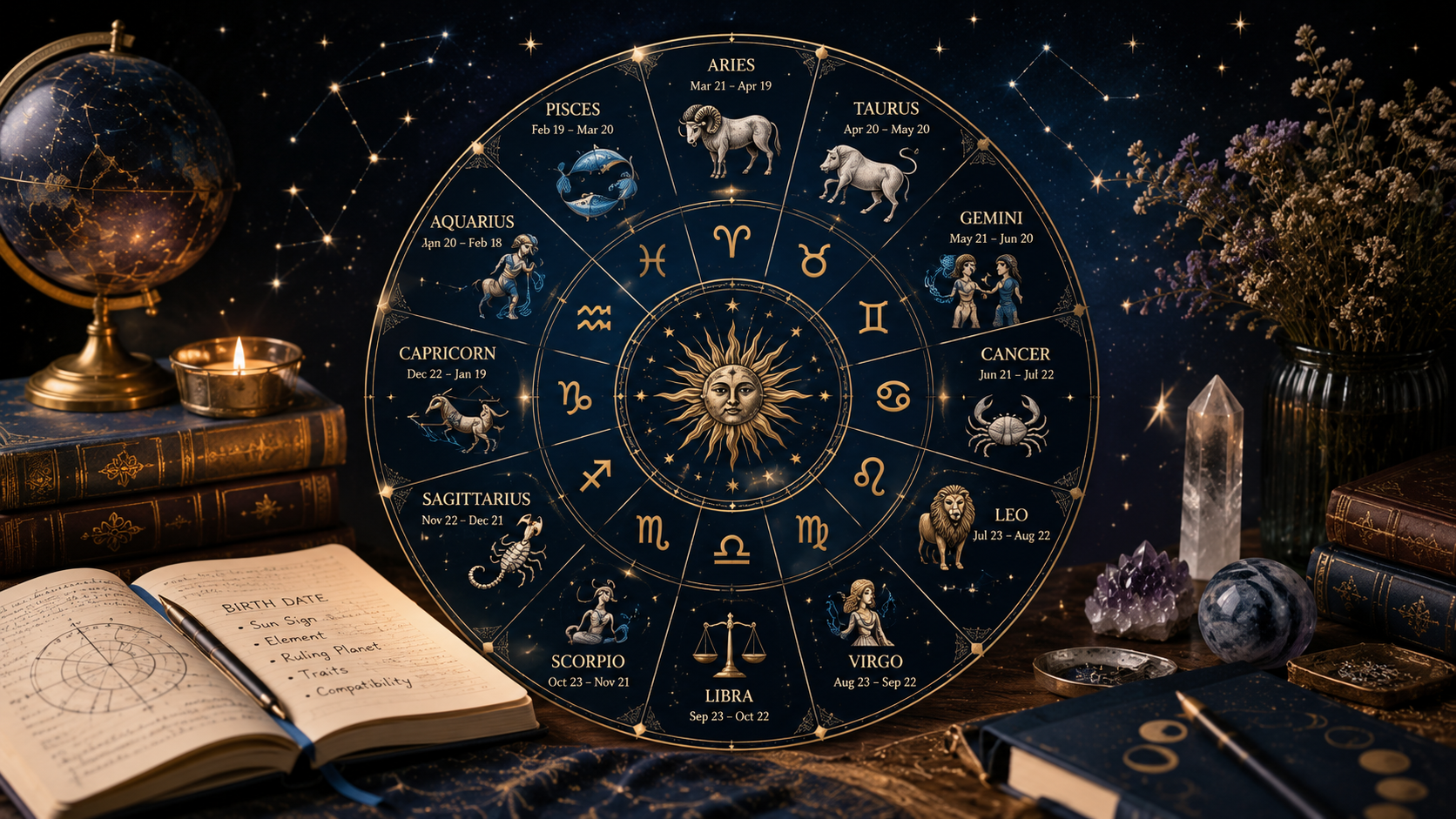
A birthday sign, or zodiac sign, is one of twelve astrological signs assigned based on the sun’s position on the date a person was born. Each sign covers roughly a one-month date range, starting with Aries (March 21–April 19) and ending with Pisces (February 19–March 20). Birthday signs come from Western astrology and are used mainly for horoscopes and personality descriptions, not scientific classification.
The Full List of Birthday Signs and Dates
Here are the twelve zodiac signs in calendar order, along with their standard date ranges:
- Aries: March 21 – April 19
- Taurus: April 20 – May 20
- Gemini: May 21 – June 20
- Cancer: June 21 – July 22
- Leo: July 23 – August 22
- Virgo: August 23 – September 22
- Libra: September 23 – October 22
- Scorpio: October 23 – November 21
- Sagittarius: November 22 – December 21
- Capricorn: December 22 – January 19
- Aquarius: January 20 – February 18
- Pisces: February 19 – March 20
These date ranges are the most commonly used version, though you may notice slight variations of a day or two between different calendars, apps, and astrologers. That small variation is normal and comes down to how each source rounds the sun’s exact position for a given year.
Where Birthday Signs Come From
The Basics of Western Astrology
Birthday signs are part of Western astrology, a system that divides the sky into twelve sections called the zodiac, based on the path the sun appears to travel over the course of a year. Each section is associated with a constellation and a set of personality traits. When someone says “I’m a Leo,” they mean the sun was positioned in the Leo section of the zodiac on the day they were born.
This system dates back thousands of years to ancient Babylon, where early astronomers tracked the sun, moon, and visible planets against a backdrop of stars. The framework was later refined by Greek astronomers and philosophers, which is why most of the sign names, like Aries, Taurus, and Gemini, come from Latin and Greek words.
Sun Signs vs. Other Parts of a Birth Chart
A birthday sign, or sun sign, is only one piece of what astrologers call a full birth chart. A complete chart also includes a moon sign, based on where the moon was positioned, and a rising sign, based on what was on the horizon at the exact time of birth. Most casual horoscopes and personality quizzes only use the sun sign because it’s the easiest to calculate. You only need a birth date, not a birth time or location, which is why it became the most widely recognized part of astrology.
Why Birthday Signs Matter to People
For many, the appeal isn’t about scientific accuracy. It’s about a shared, low-stakes way to talk about personality and connect with others. Horoscope columns, astrology apps, and compatibility quizzes turned zodiac signs into a common cultural reference point, similar to a Myers-Briggs type or a favorite Hogwarts house.
Some people take astrology seriously as a personal or spiritual practice, using birth charts to reflect on their behavior or relationships. Others treat it purely as entertainment. Both approaches are common, and neither one is right or wrong. What matters is understanding that birthday signs represent a belief system and cultural tradition, not a scientifically tested method for predicting personality or future events.
How to Find Your Birthday Sign
- Find your exact date of birth. You only need the month and day, not the year or time, to determine a sun sign.
- Check your date against the zodiac calendar above. Match your birth date to the range it falls within.
- Watch for cusp dates. If your birthday falls on the first or last day of a sign’s range, you may be considered a “cusp” birth, which is explained in more detail below.
- Use a birth chart calculator for more depth. If you want your moon sign or rising sign as well, you’ll need your exact birth time and location, which most free online birth chart tools can calculate for you.
Understanding Cusp Birthdays
A cusp birthday is one that falls close to the boundary between two zodiac signs, generally within a day or two of the listed cutoff. Someone born on April 19, for example, sits right on the edge between Aries and Taurus.
Cusp confusion happens because the exact date the sun moves from one zodiac sign to the next changes slightly from year to year. This happens because a calendar year doesn’t line up perfectly with the time it takes Earth to orbit the sun, so the boundary date can shift by about a day depending on the specific year someone was born.
If your birthday falls on a cusp date, the most accurate way to confirm your sign is to look up the sun’s exact position for your specific birth year, rather than relying on the general date ranges most calendars use. Some astrology apps and birth chart calculators can do this for you automatically.
Common Mistakes and Misconceptions
Assuming zodiac dates are fixed and identical every year. As explained above, the exact transition dates between signs can shift by a day depending on the year. The ranges listed in this guide are the most commonly used averages, not an exact match for every single year.
Confusing Western astrology with Chinese astrology. Chinese zodiac signs are based on birth year, not birth month, and use twelve different animal-based signs like Dragon, Rabbit, and Ox. Someone can have both a Western birthday sign and a Chinese zodiac sign, since the two systems are separate and unrelated.
Treating a sun sign as a complete personality profile. A sun sign is only one factor in a full astrological chart. Astrologers who take the practice seriously typically look at several chart elements together rather than judging someone’s personality from their sun sign alone.
Believing astrology is scientifically proven. Astrology has not been validated by scientific research as a predictor of personality or life events. It’s best understood as a cultural and personal belief system rather than an evidence-based science.
Real-World Examples
Someone born on July 15 falls solidly within the Cancer range (June 21–July 22), so there’s no ambiguity there. But someone born on August 22 sits right at the edge between Leo and Virgo, since the cutoff date can shift slightly depending on the year. In that case, checking a birth chart calculator with the exact birth year gives a more reliable answer than a general calendar.
Another common scenario: two friends born a week apart, one on December 20 and one on December 23, might assume they share a sign since their birthdays are close. In reality, the first falls under Sagittarius while the second falls under Capricorn, since December 21 or 22 marks the boundary between the two signs.
Key Facts About Birthday Signs
- There are twelve zodiac signs, each covering roughly a one-month period.
- Birthday signs are also called sun signs, since they’re based on the sun’s position at birth.
- The zodiac system originated in ancient Babylon and was later developed further by Greek astronomers.
- A sun sign only requires a birth date, while a full birth chart also requires birth time and location.
- Cusp dates can shift by about a day depending on the specific birth year.
- Western astrology and Chinese astrology are separate systems based on different calendars.
- No scientific evidence supports astrology as an accurate predictor of personality or future events.
Frequently Asked Questions
Q1: What is a birthday sign?
Ans: A birthday sign, or zodiac sign, is an astrological sign assigned based on the sun’s position on someone’s date of birth. There are twelve signs, each covering about a month of the calendar year.
Q2: How do I find my birthday sign?
Ans: Match your birth month and day to the zodiac date ranges. If your birthday falls near the edge of a range, a birth chart calculator using your exact birth year will give the most accurate answer.
Q3: Why do zodiac dates sometimes vary between sources?
Ans: Zodiac transition dates can shift by a day depending on the specific year, since a calendar year doesn’t align perfectly with Earth’s orbit. Most calendars use rounded, average dates for simplicity.
Q4: Is astrology scientifically accurate?
Ans: No. Astrology is not supported by scientific research as an accurate predictor of personality or events. It’s widely practiced as a cultural tradition and personal belief system rather than an evidence-based science.
Q5: Are Western and Chinese zodiac signs the same thing?
Ans: No. Western zodiac signs are based on birth month, while Chinese zodiac signs are based on birth year and use different animal-based symbols. The two systems are unrelated.
Q6: What’s the difference between a sun sign and a full birth chart?
Ans: A sun sign only reflects the sun’s position at birth. A full birth chart also includes a moon sign and rising sign, which require an exact birth time and location to calculate.
Q7: What should I know before reading into my sign?
Ans: Treat sun sign descriptions as general and broad rather than a precise personal analysis. If your birthday falls on a cusp date, double-check your sign using your exact birth year for accuracy.
Key Takeaways
- Birthday signs, or sun signs, are based on the sun’s position on someone’s date of birth and follow a twelve-sign zodiac calendar.
- The system traces back to ancient Babylon and was later shaped by Greek astronomy.
- Zodiac date ranges can shift slightly by year, which is why cusp birthdays sometimes cause confusion.
- A sun sign is just one part of a full astrological birth chart, which also includes a moon sign and rising sign.
- Western and Chinese zodiac systems are different and unrelated to each other.
- Astrology is a cultural and personal belief system, not a scientifically validated method of predicting personality or events.
Conclusion
Birthday signs have stuck around for thousands of years because they give people an easy, familiar way to talk about personality and connect over something in common. Knowing the full zodiac calendar, understanding how cusp dates work, and recognizing the difference between a sun sign and a full birth chart makes it easier to use this information accurately, whether it’s for a quick horoscope check or a deeper interest in astrology.
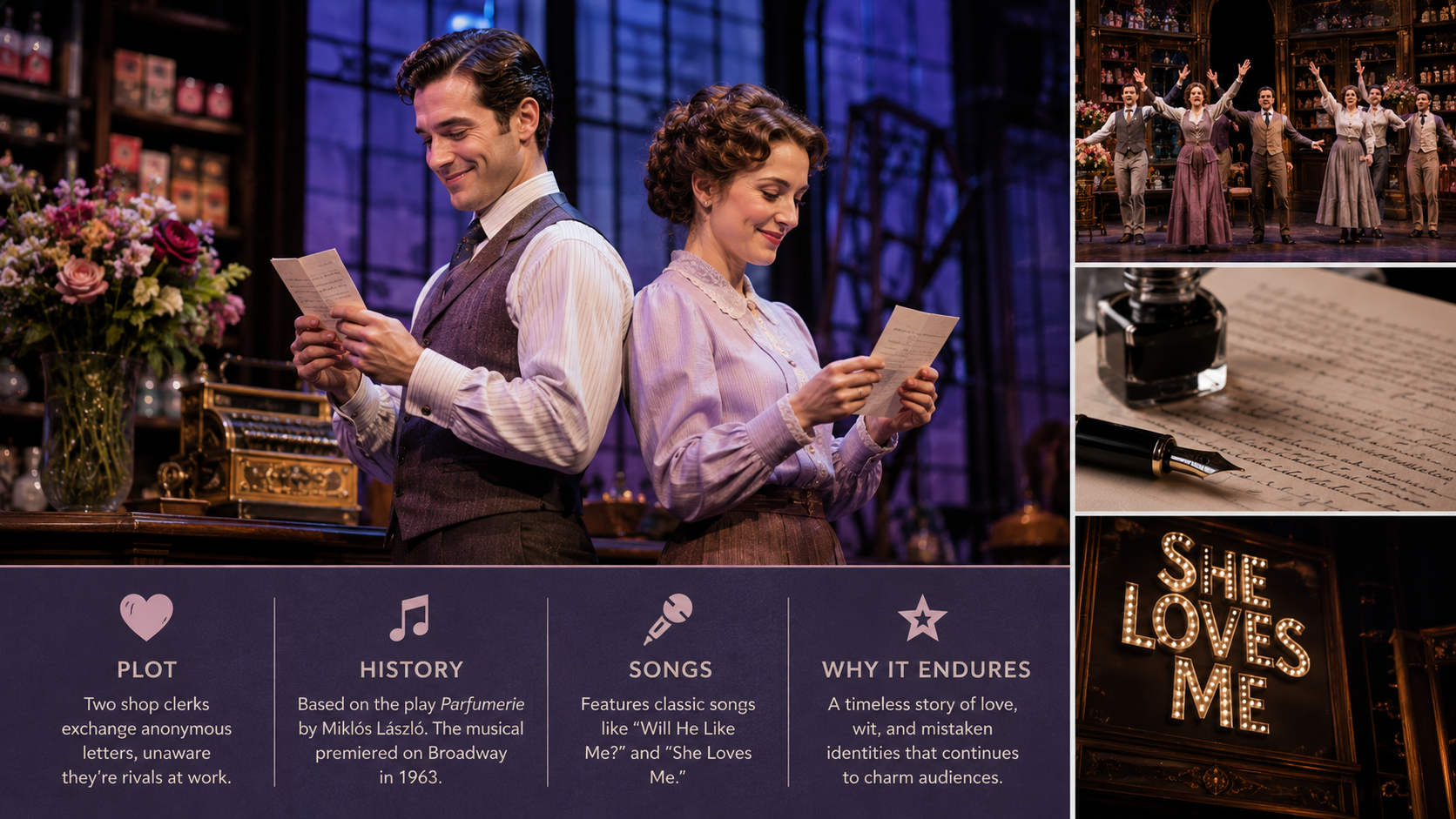
Some musicals arrive with spectacle — huge casts, elaborate scenery, and productions that fill every inch of a Broadway stage. She Loves Me is not that kind of show. It is smaller, quieter, and more intimate. And for a very specific kind of musical theatre lover, that’s exactly why it’s perfect.
First staged on Broadway in 1963, She Loves Me has earned a devoted following across more than six decades. It has been revived twice on Broadway, twice in London’s West End, and continues to be produced regularly in regional theatres and schools around the world. If you’ve ever seen the Tom Hanks and Meg Ryan film You’ve Got Mail, you already know the story — even if you didn’t realize it at the time.
This article covers everything worth knowing about She Loves Me: where it came from, what it’s about, who wrote it, what the major productions looked like, and why it remains one of the most beloved chamber musicals in the Broadway canon.
What Is She Loves Me?
Quick Answer
She Loves Me is a Broadway musical with book by Joe Masteroff, music by Jerry Bock, and lyrics by Sheldon Harnick. Set in a Hungarian parfumerie in the 1930s, it follows two bickering coworkers — Georg and Amalia — who are secretly pen pals and unknowingly falling in love through their anonymous letters. The show premiered on Broadway on April 23, 1963, and has been revived twice on Broadway (1993 and 2016).
The Source Material: Where the Story Comes From
She Loves Me is the third major adaptation of a 1937 Hungarian play called Parfumerie, written by playwright Miklós László.
That single play has had a remarkable afterlife. Ernest Lubitsch adapted it first as the 1940 film The Shop Around the Corner, starring Jimmy Stewart and Margaret Sullavan — a film widely regarded as one of the finest romantic comedies in Hollywood history. A musical version followed in 1949 as In the Good Old Summertime, with Judy Garland and Van Johnson relocating the story to a Chicago music shop.
Then came She Loves Me in 1963 — the first full stage musical adaptation, returning the setting to a European parfumerie and restoring the Budapest atmosphere of the original play.
The same story was adapted again in 1998 as You’ve Got Mail, the Nora Ephron film starring Tom Hanks and Meg Ryan, where the anonymous correspondence was updated for the era of early internet chat rooms. This connection makes She Loves Me surprisingly familiar to people who have never seen it on stage — the emotional backbone of that beloved film traces directly back to this musical.
The Creative Team
She Loves Me was created by a team whose next project would become one of the most celebrated musicals ever written.
Joe Masteroff wrote the book. He adapted László’s play with a careful hand, preserving the romantic tensions and comedic misunderstandings while shaping it for the musical stage.
Jerry Bock composed the music. Bock had already won a Tony for Fiorello! in 1960 and would go on to write the score for Fiddler on the Roof in 1964 — the show that immediately followed She Loves Me and became a Broadway landmark. The score for She Loves Me is considered among his most musically sophisticated work.
Sheldon Harnick wrote the lyrics. Harnick was Bock’s longtime collaborator and brought to She Loves Me a wit and emotional precision that has made the show’s songs endure long after the original run. Like Bock, he won a Grammy for the original cast recording of She Loves Me, and later won a Tony for Fiddler on the Roof.
The original production was directed and produced by Harold Prince, then in the early stages of what would become one of the most celebrated careers in Broadway history.
The Plot of She Loves Me
The story takes place in Mr. Maraczek’s Parfumerie — an elegant perfume shop in 1930s Budapest. The shop’s staff includes a handful of colorful characters, but the central relationship belongs to two salespeople: Georg Nowack and Amalia Balash.
Georg and Amalia cannot stand each other. They bicker over everything — work, customers, values, temperament. Their colleagues find it exhausting. The audience, however, can see what Georg and Amalia cannot: the chemistry underneath all that friction is obvious from the start.
What neither of them knows is that each has been corresponding anonymously with a mysterious romantic pen pal — addressed simply as “Dear Friend.” Their letters are tender, thoughtful, and full of genuine feeling. They have arranged to meet in person for the first time, at a café, carrying a book and a rose as identifying signals.
At the café, Georg arrives first — and discovers that his “Dear Friend” is Amalia.
He doesn’t tell her. Thrown off balance by the revelation, he retreats. Amalia is stood up by her unknown correspondent and goes home heartbroken. Georg begins to process what he’s discovered — that the woman he argued with every day, the woman he thought he disliked, is the person he’s been falling in love with through letters.
From that midpoint, the rest of the show traces Georg’s gradual reconciliation with what he feels, Amalia’s confusion as her coworker starts treating her with unexpected kindness, and the eventual moment when both of them face the full truth of their situation.
The resolution is warm and genuinely earned — one of the more satisfying endings in the Broadway repertoire, precisely because the show takes its time building to it.
Supporting Characters
The parfumerie staff provide both comedy and emotional texture throughout the show:
Steven Kodaly is the shop’s vain charmer and resident schemer — stylish, unreliable, and entertaining. He is romantically entangled with his colleague Ilona but treats the relationship casually.
Ilona Ritter is sharp, funny, and deeply aware of her own situation. She puts up with Kodaly far longer than she should, but her arc through the show includes a satisfying moment of personal clarity.
Ladislav Sipos is a mild-mannered, sensible colleague who serves as a quiet voice of steadiness amid the romantic chaos around him.
Arpad is the eager young delivery boy, full of ambition and comic energy.
Mr. Maraczek is the shop’s proprietor — dignified, complicated, and carrying his own quiet sadness that runs beneath the lighter surface of the story.
The Songs
She Loves Me is a chamber musical, which means its songs tend to be character-driven and intimate rather than large-scale. They reveal interior states, deepen relationships, and carry the emotional logic of the story forward. The show is structured so that songs emerge naturally from scenes rather than interrupting them — a quality that distinguishes it from more spectacle-driven musicals.
Several songs have become central pieces of the musical theatre repertoire:
“She Loves Me” — Georg’s exhilarated realization, sung when the truth of his feelings finally catches up with him. It is one of the most purely joyful songs in the Broadway canon: a man stunned by his own happiness.
“Vanilla Ice Cream” — Amalia’s late-night solo, written while she is sick in bed and has received a mysterious bouquet of flowers from an unknown admirer (Georg, in disguise). The song turns a small domestic moment — eating ice cream alone — into something unexpectedly rapturous. It was made famous by Barbara Cook in the original production and has remained a definitive audition piece for sopranos ever since.
“Will He Like Me?” — Amalia’s nervous anticipation before the café meeting with her pen pal. It captures the specific anxiety of being about to meet someone you’ve only known through letters — a feeling that resonates today even with technology changing how people meet.
“Dear Friend” — Amalia’s heartbroken solo after being stood up at the café. A quiet, aching song that shifts the tone of the second act.
“Ilona” — An ensemble number built around Ilona’s realization about her worth and the casual way Kodaly has treated her.
“A Trip to the Library” — One of the show’s lighter comic numbers, in which Ilona recounts an unexpected intellectual awakening.
The score as a whole won a Grammy Award for the original cast recording.
The Original 1963 Broadway Production
She Loves Me opened at the Eugene O’Neill Theatre on April 23, 1963, and ran for 302 performances, closing on January 11, 1964.
The original cast starred:
- Barbara Cook as Amalia Balash
- Daniel Massey as Georg Nowack
- Jack Cassidy as Steven Kodaly
- Barbara Baxley as Ilona Ritter
- Ludwig Donath as Mr. Maraczek
- Nathaniel Frey as Ladislav Sipos
Jack Cassidy won the Tony Award for Best Actor in a Featured Role in a Musical for his performance as Kodaly. The production received additional Tony nominations but is considered to have been somewhat overshadowed in its original season by competition from other shows.
Barbara Cook’s performance as Amalia became the defining interpretation of the role. Her soprano voice — clear, emotionally direct, and technically exceptional — suited the material perfectly. Her rendition of “Vanilla Ice Cream” became legendary in musical theatre circles, and the connection between Cook and the song followed her throughout her life. When she passed away in August 2017, tributes noted that her last meal was vanilla ice cream — a detail that her family shared publicly as a meaningful final nod to the role.
The original cast recording won a Grammy Award for Best Score from an Original Cast Show Album, confirming the score’s quality even as the original run ended after a modest 302 performances.
The 1993 Broadway Revival
The first Broadway revival opened in 1993 at the Roundabout Theatre Company — marking the first musical in that company’s Broadway history — and ran to enthusiastic critical response.
This revival starred Boyd Gaines as Georg and Judy Kuhn as Amalia, with Howard McGillin as Kodaly and Sally Mayes as Ilona. The direction was by Scott Ellis.
The 1993 production earned the Drama Desk Award for Outstanding Revival of a Musical and helped introduce She Loves Me to a new generation of theatre audiences. A subsequent London production opened in 1994 at the Savoy Theatre, winning the Laurence Olivier Award for Best Musical Revival.
The 2016 Broadway Revival
The second Broadway revival opened on March 17, 2016, at Studio 54 — produced again by the Roundabout Theatre Company and directed once more by Scott Ellis.
This production starred:
- Laura Benanti as Amalia Balash
- Zachary Levi as Georg Nowack
- Jane Krakowski as Ilona Ritter
- Gavin Creel as Steven Kodaly
- René Auberjonois as Mr. Maraczek
- Michael McGrath as Ladislav Sipos
- Nicholas Barasch as Arpad
The 2016 revival ran through July 10, 2016 — a limited engagement — and received strong critical notices. The Associated Press called it a show with “an astounding cast, a nifty story and memorable songs” that turned the revival into a “celebration of classic musical construction.”
The production made history on June 30, 2016, when it became the first Broadway production ever to be livestreamed online. BroadwayHD broadcast the performance live, and it was subsequently aired multiple times on PBS’s Great Performances program, making it one of the most widely seen stage recordings of any Broadway show.
The revival received the Drama Desk Award for Outstanding Revival of a Musical in 2016. It received a Tony Award nomination — won by David Rockwell for scenic design — and earned nine nominations total.
Why She Loves Me Endures
Several qualities help explain why this relatively modest show — no grand spectacle, no huge chorus, no dramatic historical backdrop — continues to hold its place in the musical theatre repertoire more than sixty years after its premiere.
The score is genuinely exceptional. Bock and Harnick wrote music that rewards careful listening. The songs advance character and situation rather than pausing the story for applause moments. Few composers have integrated music and drama as organically as this score does.
The story is universal. Two people who misread each other, fall in love through a medium that strips away their defenses, and have to reckon with the gap between who they think someone is and who that person really is — this is a story that feels contemporary regardless of when it’s set. The Budapest parfumerie setting adds charm, but the emotional core needs no updating.
It scales beautifully. As a chamber musical with a small orchestra and a modest cast, She Loves Me can be produced at a fraction of the cost of most Broadway-scale shows. This has made it a staple of regional theatre, college productions, and community theatre, ensuring a constant stream of new audiences finding it for the first time.
The leading roles are extraordinary. Amalia Balash in particular is one of the great soprano roles in the Broadway repertoire — intelligent, funny, vulnerable, and musically demanding. The role has attracted exceptional performers from Barbara Cook to Judy Kuhn to Laura Benanti, each finding something slightly different in the character.
Common Misconceptions About She Loves Me
“She Loves Me is based on You’ve Got Mail.” It’s actually the other way around. Both trace back to Miklós László’s 1937 play Parfumerie. She Loves Me came first as a Broadway musical in 1963; You’ve Got Mail arrived in 1998.
“The show only had one Broadway run.” It has had three: the original 1963 production and full revivals in 1993 and 2016.
“Barbara Cook won a Tony for She Loves Me.” She did not — Jack Cassidy won for his featured role. Cook’s legendary status in the show comes from the impact of her performance and recording, not a Tony win for this particular production.
Key Facts
- She Loves Me opened on Broadway on April 23, 1963, at the Eugene O’Neill Theatre
- It ran for 302 performances in its original Broadway engagement
- The creative team was Joe Masteroff (book), Jerry Bock (music), and Sheldon Harnick (lyrics)
- The original cast featured Barbara Cook, Daniel Massey, and Jack Cassidy (Tony Award winner)
- The original cast album won a Grammy Award for Best Score from an Original Cast Show Album
- The 1993 revival won the Drama Desk Award for Outstanding Revival of a Musical
- The 1994 London revival won the Laurence Olivier Award for Best Musical Revival
- The 2016 revival starred Laura Benanti, Zachary Levi, Jane Krakowski, and Gavin Creel
- The 2016 production was the first Broadway show ever livestreamed, via BroadwayHD
- The story traces back to the 1937 Hungarian play Parfumerie by Miklós László
- Other adaptations of the same source material include The Shop Around the Corner (1940), In the Good Old Summertime (1949), and You’ve Got Mail (1998)
Frequently Asked Questions
Q1: What is She Loves Me about?
Ans: She Loves Me is a romantic comedy musical set in a Budapest perfume shop in the 1930s. Two bickering coworkers — Georg and Amalia — are unknowingly anonymous pen pals conducting a tender romantic correspondence. The show follows their gradual discovery of each other’s true feelings.
Q2: Who wrote She Loves Me?
Ans: The book was written by Joe Masteroff, the music by Jerry Bock, and the lyrics by Sheldon Harnick. The same songwriting team (Bock and Harnick) created Fiddler on the Roof the following year.
Q3: Is She Loves Me related to You’ve Got Mail?
Ans: Yes, but She Loves Me came first. Both are adaptations of the same source material — the 1937 Hungarian play Parfumerie by Miklós László. She Loves Me opened on Broadway in 1963; You’ve Got Mail was released in 1998.
Q4: When did She Loves Me first open on Broadway?
Ans: The original Broadway production opened on April 23, 1963, at the Eugene O’Neill Theatre and ran for 302 performances.
Q5: Who starred in the original She Loves Me?
Ans: Barbara Cook played Amalia, Daniel Massey played Georg, Jack Cassidy played Kodaly, and Barbara Baxley played Ilona Ritter. Cassidy won a Tony Award for his performance.
Q6: Has She Loves Me been revived on Broadway?
Ans: Twice. The first revival was in 1993 with Boyd Gaines and Judy Kuhn. The second was in 2016 with Laura Benanti and Zachary Levi.
Q7: Can I watch She Loves Me online?
Ans: The 2016 Broadway revival was filmed and is available through BroadwayHD, and it has aired on PBS’s Great Performances. It was the first Broadway show ever to be livestreamed, making it one of the most accessible professional recordings of a Broadway musical.
Q8: What is “Vanilla Ice Cream” in She Loves Me?
Ans: It is one of the show’s most beloved songs — a solo sung by Amalia while recovering from illness, after an unexpected delivery of flowers lifts her spirits.
Q9: Is She Loves Me appropriate for school productions?
Ans: Yes. It has a relatively modest cast size, no adult content, and accessible material. It is frequently produced in high school, college, and community theatre settings, and the rights are available through Music Theatre International (MTI).
Key Takeaways
- She Loves Me is a Broadway musical from 1963 with book by Joe Masteroff and score by Jerry Bock and Sheldon Harnick — the same songwriting duo who created Fiddler on the Roof
- The show is based on Parfumerie, a 1937 Hungarian play that also inspired The Shop Around the Corner (1940), In the Good Old Summertime (1949), and You’ve Got Mail (1998)
- The story centers on two coworkers who bicker endlessly in person while unknowingly falling in love through anonymous letters
- Barbara Cook originated the role of Amalia Balash in 1963, and her performance — particularly “Vanilla Ice Cream” — remains the definitive interpretation
- The original cast album won a Grammy Award; both Broadway revivals won Drama Desk Awards
- The 2016 revival at Studio 54, starring Laura Benanti and Zachary Levi, became the first Broadway production ever livestreamed online
She Loves Me has never been the loudest show in the room. It doesn’t need to be. Its power comes from small moments — a letter read alone, a bouquet received unexpectedly, two people slowly recognizing what they’ve felt all along. The show understands something that bigger productions sometimes miss: that the most moving theatrical moments are often the quietest ones.
That combination of a nearly perfect score, a story that resonates across generations and settings, and roles that attract exceptional performers has kept She Loves Me in production for over sixty years. It is the kind of musical that people discover once and carry with them for the rest of their lives.

Introduction
Most people don’t want to just live longer — they want to feel good while doing it. That gap between your calendar age and how you actually feel, move, and think is what researchers call “biological age,” and it turns out you have more control over it than you might think.
The question of how to stay young isn’t about chasing some fountain of youth. It’s about understanding what speeds up aging and what slows it down — then making small, consistent choices that add up over time. Some of the most powerful anti-aging tools aren’t expensive treatments or miracle supplements. They’re habits.
What Does It Mean to Stay Young?
The Difference Between Biological and Chronological Age
Your chronological age is just the number of years you’ve been alive. Your biological age is a measure of how well your cells, tissues, and organs are actually functioning. Two people who are both 55 can have very different biological ages depending on their lifestyle, genetics, stress levels, and health history.
Scientists measure biological age using markers like telomere length, inflammation levels, mitochondrial function, and epigenetic clocks — patterns in how genes are switched on or off. The encouraging news is that many of these markers can improve with lifestyle changes, even later in life.
Why People Age Faster Than They Should
Aging is a natural process, but certain factors accelerate it. Chronic inflammation — sometimes called “inflammaging” — is one of the biggest drivers. It damages cells, impairs organ function, and contributes to diseases like heart disease, diabetes, and Alzheimer’s. Oxidative stress, where unstable molecules called free radicals damage cells, is another key factor.
Poor sleep, a sedentary lifestyle, chronic stress, ultra-processed food, smoking, and excess alcohol all increase inflammation and oxidative stress. That means a lot of premature aging is preventable.
How to Stay Young: The Core Habits
Move Your Body Every Day
Physical activity is probably the most evidence-backed longevity tool we have. Regular exercise reduces inflammation, improves cardiovascular health, maintains muscle mass, supports brain function, and even lengthens telomeres — the protective caps on chromosomes that shorten with age.
You don’t need to run marathons. Research consistently shows that 150 minutes of moderate activity per week — things like brisk walking, cycling, or swimming — is enough to significantly reduce disease risk and extend healthy life expectancy. Strength training is particularly important as you get older because muscle mass naturally declines with age, a process called sarcopenia. Lifting weights two or three times a week counteracts this and helps maintain metabolism, balance, and bone density.
Movement throughout the day matters too. Sitting for long stretches, even if you exercise regularly, is independently linked to faster aging. Short walks, standing breaks, and simply taking the stairs all count.
Prioritize Sleep Like It’s Non-Negotiable
Sleep is when your body does most of its repair work. During deep sleep, the brain flushes out waste products, including amyloid-beta proteins linked to Alzheimer’s disease. Cells regenerate, hormones reset, and the immune system is calibrated.
Chronic sleep deprivation accelerates nearly every marker of aging. It raises cortisol, increases inflammation, impairs memory, disrupts metabolism, and weakens immune defenses. Most adults need seven to nine hours a night for optimal function — not as a luxury, but as a biological necessity.
Good sleep hygiene goes a long way. Keeping a consistent sleep schedule, avoiding screens before bed, keeping your bedroom cool and dark, and limiting caffeine after early afternoon all improve sleep quality. If you regularly wake up tired despite adequate hours in bed, it’s worth talking to a doctor about conditions like sleep apnea.
Eat to Reduce Inflammation
What you eat has a direct effect on inflammation levels in your body. The Mediterranean diet — built around vegetables, fruits, whole grains, legumes, nuts, olive oil, and fish — consistently ranks among the most studied and most supported dietary patterns for longevity. It’s rich in antioxidants, omega-3 fatty acids, and fiber, all of which work against inflammation.
Ultra-processed foods, refined sugars, and trans fats have the opposite effect. They spike blood sugar, promote inflammation, and are associated with faster cellular aging. Replacing even a portion of processed food with whole food has measurable effects.
A few specific nutrients deserve attention:
- Antioxidants (found in berries, leafy greens, dark chocolate, and colorful vegetables) neutralize free radicals
- Omega-3 fatty acids (found in salmon, sardines, walnuts, and flaxseeds) reduce inflammation
- Polyphenols (found in green tea, olive oil, and berries) support cellular repair
- Protein from diverse sources maintains muscle mass as you age
- Fiber feeds the gut microbiome, which plays a surprisingly large role in immune function and inflammation
Caloric restriction and time-restricted eating (like eating within an 8–10 hour window) have shown promise in animal studies and some human research for activating cellular cleanup processes called autophagy. The science is still developing, but reducing late-night eating and not grazing constantly appears to have benefits.
Manage Stress Before It Manages You
Chronic psychological stress is one of the most underappreciated drivers of accelerated aging. Stress triggers the release of cortisol, which at chronically elevated levels damages the hippocampus, impairs immune function, promotes inflammation, and has been directly linked to shorter telomere length.
Research from Nobel laureate Elizabeth Blackburn found that caregivers under chronic stress had significantly shorter telomeres than those under less stress — a biological sign of faster aging at the cellular level.
Managing stress isn’t about eliminating all difficulty from your life. It’s about building resilience and recovery. Proven strategies include:
- Regular physical activity (one reason exercise benefits mental health so powerfully)
- Mindfulness meditation, which has measurable effects on cortisol and inflammatory markers
- Social connection, which is among the most robust predictors of longevity across cultures
- Time in nature, which lowers cortisol and heart rate
- Setting realistic limits on work and commitments
Even small daily practices — five minutes of intentional breathing, a short walk without your phone, spending time with someone you care about — have cumulative effects over years and decades.
Protect and Challenge Your Brain
Cognitive aging isn’t inevitable at the pace most people fear. The brain has significant neuroplasticity — the ability to form new connections and adapt — well into old age. But it needs regular stimulation to stay sharp.
Learning new skills, reading, solving problems, playing music, and engaging in complex conversations all support cognitive reserve — essentially the brain’s resilience against age-related decline. Novelty is particularly important; the brain responds to new challenges more than to familiar routines.
Physical exercise directly benefits the brain by increasing blood flow and stimulating the production of BDNF (brain-derived neurotrophic factor), a protein that supports neuron growth and survival. Sleep, as mentioned earlier, is critical for memory consolidation and waste clearance. And chronic stress, poor diet, and social isolation each independently increase dementia risk.
Stay Socially Connected
Loneliness is not just emotionally painful — it’s physically harmful. Research has linked social isolation to higher levels of inflammation, weaker immune response, higher blood pressure, and significantly shorter life expectancy. Some studies suggest chronic loneliness carries health risks comparable to smoking 15 cigarettes a day.
On the flip side, people with strong social ties consistently live longer, recover from illness faster, and report better quality of life. This doesn’t require a large social network. Even a few close, trusting relationships appear to be what matters most.
Investing in relationships — showing up, staying in touch, building community — is genuinely one of the most powerful longevity habits available.
Avoid the Things That Age You Fastest
While building good habits matters, avoiding the biggest accelerators of aging has enormous impact:
- Smoking is among the most powerful accelerators of cellular aging, affecting virtually every organ system
- Excess alcohol damages the liver, disrupts sleep, increases cancer risk, and promotes inflammation
- Chronic sleep deprivation accelerates nearly every aging marker
- Prolonged sun exposure without protection damages DNA in skin cells and accelerates skin aging
- Sedentary behavior promotes metabolic dysfunction and muscle loss
- High blood sugar and insulin resistance, often driven by diet, accelerate vascular aging and cognitive decline
Common Misconceptions About Staying Young
Anti-aging is mostly about skincare
Skin health matters, and protecting your skin from sun damage has real benefits. But skincare addresses surface appearance. The deeper drivers of aging — inflammation, metabolic health, sleep, stress — aren’t solved by topical products.
Supplements can replace a healthy lifestyle
Some supplements have evidence behind them (vitamin D and omega-3s, for instance, in people who are deficient or don’t eat fish). But no supplement replicates the systemic benefits of exercise, sleep, and a whole-food diet. The supplement industry is poorly regulated and full of overblown claims.
Aging fast is just genetics
Genetics play a role — roughly 20–30% of your longevity is thought to be determined by genes. The rest is lifestyle and environment. This means the majority of how you age is within your influence.
It’s too late to start
Studies consistently show that people who adopt healthier habits in midlife or even later life see meaningful improvements in biological markers of aging. Starting at 50 is far better than not starting at all.
Step-by-Step: Building Anti-Aging Habits That Stick
- Start with sleep. Fix your sleep before anything else: A consistent bedtime and wake time, a dark and cool room, and a wind-down routine make a disproportionate difference in how you feel and function.
- Add daily movement. Start with a 20–30 minute walk each day: Once that’s consistent, add two strength training sessions per week.
- Shift your eating gradually. You don’t need to overhaul your diet overnight: Add a vegetable to each meal, swap refined grains for whole grains, and reduce how often you eat processed food.
- Build a stress outlet: Choose one stress-management practice — meditation, exercise, journaling, time in nature — and make it a non-negotiable part of your week.
- Invest in relationships: Schedule time with people who matter to you. Loneliness is insidious because it creeps up gradually; staying connected requires intentional effort.
- Get regular health screenings: Many age-related diseases are far more treatable when caught early. Blood pressure, blood sugar, cholesterol, and cancer screenings all matter.
Key Facts About Staying Young
- Regular physical activity can add an estimated three to seven years of healthy life expectancy
- People who sleep fewer than six hours a night consistently show accelerated cellular aging markers
- The Mediterranean diet is associated with up to 25% lower risk of premature death across multiple large studies
- Chronic loneliness increases mortality risk by approximately 26%, comparable to well-known physical health risks
- Smoking accelerates biological aging by an estimated 7–10 years compared to non-smokers
- Telomere length — a marker of cellular age — has been shown to increase in response to lifestyle changes including exercise and stress reduction
- People with strong social connections are 50% more likely to survive to a given age than those with poor social ties
Frequently Asked Questions
Q1: What actually makes people age faster?
Ans: The main drivers of accelerated aging are chronic inflammation, oxidative stress, poor sleep, sedentary behavior, chronic psychological stress, smoking, excess alcohol, and diets high in ultra-processed foods and refined sugars. These factors damage cells, shorten telomeres, and impair the body’s repair mechanisms.
Q2: Can you reverse aging, or only slow it?
Ans: You can’t reverse chronological age, but research shows that biological aging markers — including inflammation levels, telomere length, and cardiovascular function — can genuinely improve with lifestyle changes. Some studies using epigenetic clocks have shown measurable biological “de-aging” in participants who adopted specific interventions.
Q3: What’s the most important anti-aging habit?
Ans: There’s no single most important habit, but exercise consistently emerges as the most well-supported intervention across the most domains: it improves cardiovascular health, brain function, muscle mass, metabolism, mood, sleep, and inflammation simultaneously.
Q4: Does intermittent fasting help with aging?
Ans: Time-restricted eating appears to activate autophagy — a cellular cleanup process — and has shown benefits for metabolic health in some studies. It’s a promising area of research, though the evidence in humans is still developing. It’s not right for everyone, particularly those with a history of disordered eating or certain medical conditions.
Q5: How much does genetics affect how fast you age?
Ans: Estimates vary, but genetics are thought to account for roughly 20–30% of longevity variation. The remaining 70–80% is attributed to lifestyle and environmental factors — meaning your daily choices have a substantial impact on how you age.
Q6: Can stress really make you age faster?
Ans: Yes, and there’s solid biological evidence for it. Chronic stress elevates cortisol, increases systemic inflammation, and has been directly linked to shorter telomere length in multiple studies. Managing stress is a genuine anti-aging strategy, not just a wellness cliché.
Q7: What foods help you stay younger longer?
Ans: Foods consistently associated with slower aging include leafy greens, berries, fatty fish, olive oil, nuts, legumes, whole grains, and green tea. These foods are rich in antioxidants, anti-inflammatory compounds, fiber, and nutrients that support cellular repair and reduce chronic disease risk.
Key Takeaways
- Biological age — not just chronological age — is significantly shaped by lifestyle choices
- Regular physical activity, including both cardio and strength training, is the most evidence-backed longevity habit
- Quality sleep (7–9 hours) is a biological necessity, not a luxury, and directly affects how fast you age
- An anti-inflammatory diet rich in whole foods, especially the Mediterranean-style pattern, is consistently linked to longer, healthier life
- Chronic stress and loneliness both accelerate cellular aging in measurable ways
- Avoiding major accelerators — smoking, excess alcohol, chronic sleep deprivation — has as much impact as adopting positive habits
- It is never too late to benefit from healthier habits; improvements in biological markers are documented at all ages
Conclusion
Staying young isn’t a mystery, and it doesn’t require extreme measures. The biology of aging is increasingly well understood, and the levers that influence it are mostly within your control — how you move, sleep, eat, manage stress, and connect with others.
None of these habits need to be perfect. The research on aging consistently shows that consistency over time matters far more than any single perfect week. Small, sustainable changes compounded over years are what actually shift biological age.
The best time to start is now — not because aging is something to fear, but because the choices you make today shape how you feel, think, and move for decades to come.
-

 Technology2 months ago
Best Wireless Earbuds Under 200 Dollars 2024: What to Know Before You Buy
-

 News4 months ago
Best Places to See Penguins in the Wild: A Complete Guide
-

 Technology4 months ago
What Is VIPstand? How It Works, Legal Risks, and What You Should Know
-

 News4 months ago
Lake Mead Water Levels: Status, History & Western Impact
-

 Technology4 months ago
Laaster: Meaning, Origins, and What It Says About Harmful Speech
-

 Celebrity4 months ago
Matt Danzeisen: Who He Is, His Career in Finance, and His Life With Peter Thiel
-

 News4 months ago
What Is Epoch Fun? A Complete Guide to the Epoch Times Games Section
-

 Food2 months ago
Best Arroz con Leche Boliviano Near Me: What to Look For